Notes
Webflow maintenance retainer: what it actually covers
What I actually do on a Webflow retainer, how I price it and what I quote separately. Based on two AI companies I've worked with for over a year.

What I actually do on a Webflow retainer, how I price it and what I quote separately. Based on two AI companies I've worked with for over a year.
The question: What does a Webflow maintenance retainer cover, and how is it priced?
Short answer: A Webflow retainer is a fixed monthly fee for an agreed number of hours from a developer who already knows your site. It covers new landing pages, new sections, bug fixes, content and CMS changes. Hours above the agreed amount are billed hourly. Large rebuilds usually get their own fixed price.
Who it's for: Marketing teams at B2B and SaaS companies that ship new pages often and don't want to brief a new freelancer every time.
I've looked after two sites for more than a year each. AI Digital for almost two years, where I do the Webflow development on a big marketing site. And arthur.ai for over a year, where I did both design and development. Both are AI companies, so there is something new to put on the site almost every week.
This is what that work looks like from my side: what comes in, how I bill it, how fast I answer, and what I quote separately.
A Webflow maintenance retainer covers the work a marketing site needs after launch: new landing pages, new sections on existing pages, bug fixes, content swaps and CMS changes. When I also design for the client, it includes design too, so a new page can start as a doc and end as a live page.
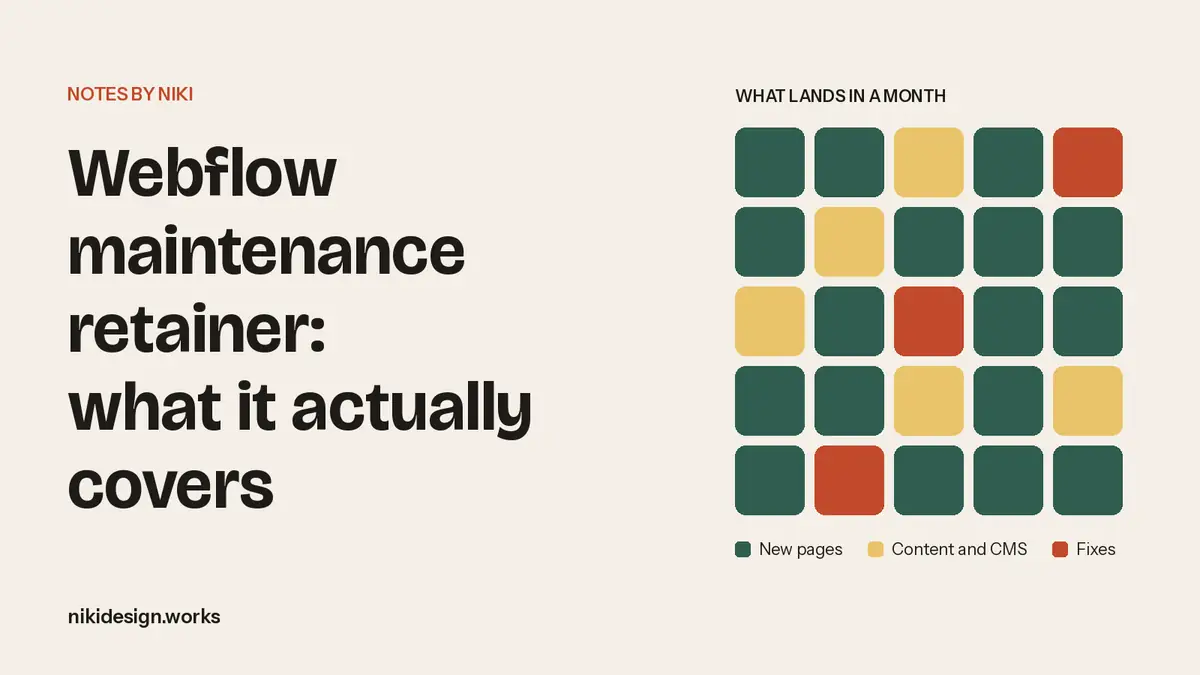
Here is what actually lands in my Slack on the AI Digital site:
At arthur.ai the work started earlier in the process. A new page often arrived as plain text in a Google Doc. I designed it, went through with their team what should be on it, iterated, and then built it in Webflow.
One thing you don't pay for on a Webflow retainer is server upkeep. Webflow runs the hosting, SSL and backups itself, and its hosting page says there are no updates or packages to install. So every hour I bill goes into the pages your visitors see.
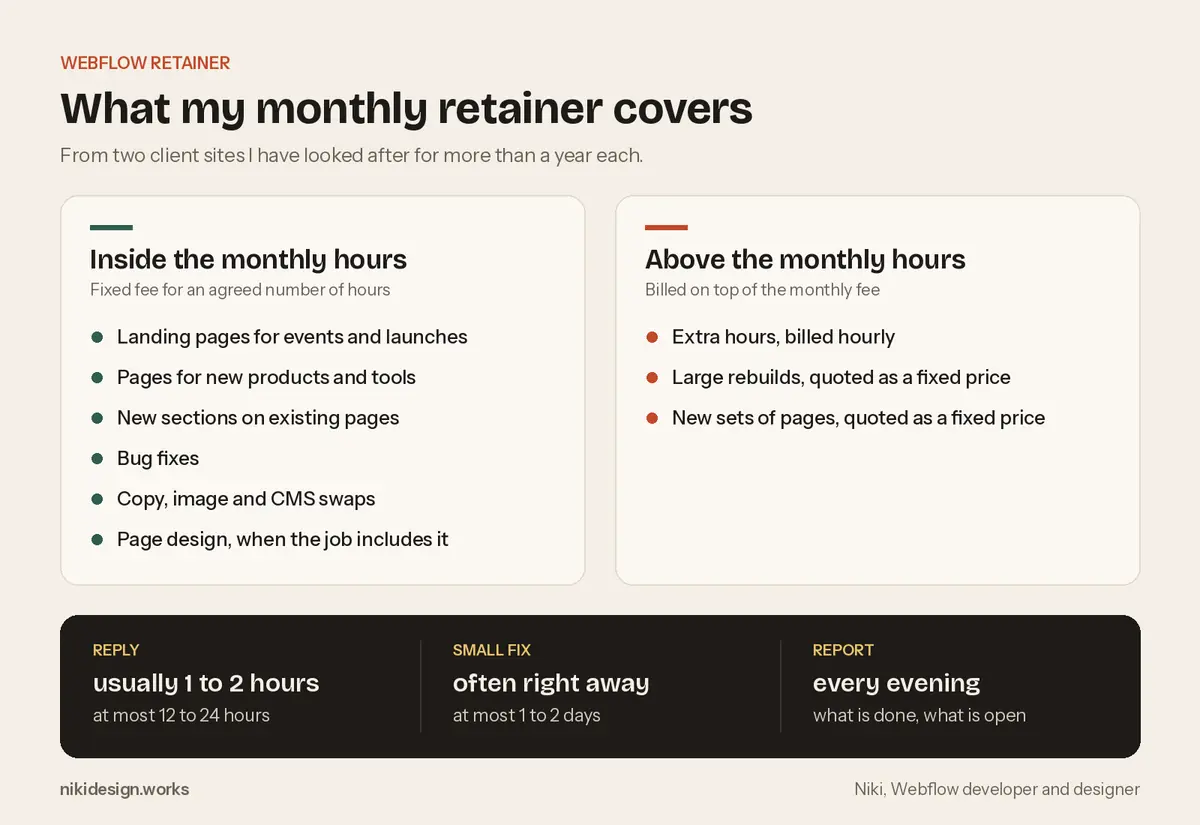
I price a retainer as a fixed monthly fee that covers an agreed number of hours. If a month needs more, the extra hours are billed at my hourly rate. Big pieces of work, like a rebuild or a new set of pages, I usually quote as a separate fixed price.
The fixed fee gives the client a number they can put in the budget. It also means I keep those hours free for them, so a request doesn't wait behind other projects.
It doesn't have to be a retainer. With arthur.ai I never had one. I worked hourly for a year and that worked fine for both of us.
| Setup | How it's billed | When I use it |
|---|---|---|
| Retainer | Fixed monthly fee for agreed hours, extra hours billed hourly | Ongoing pages, fixes and CMS changes |
| Hourly | Every hour billed as it's worked | Steady work with no fixed monthly volume, like arthur.ai |
| Fixed price | One quote for the whole scope | Rebuilds and new sets of pages |
Nothing is off limits on my retainers. Work above the agreed monthly hours is billed hourly. For a large rebuild or a batch of new pages I usually suggest a fixed price instead, so the client knows the full cost before I start and the monthly hours stay free for small requests.
For example, a landing page for an event next week goes into the monthly hours. A whole new part of the site with its own templates and CMS collection would get its own quote.
I usually reply within one to two hours. If the task is small, I do it right away. If I'm away from my laptop, a reply can take up to 12 to 24 hours, and a small fix is done within one or two days at the latest.
Requests come in through Slack and through whatever project tool the client already uses. Every team has a different one, so I work in theirs. At the end of each working day I send a short report of what I did and what's still open.
Because a developer who already knows the build starts working the moment a request arrives. A new freelancer needs a call, a walkthrough of the site and time to understand how it was built before changing anything. On a site that gets small requests every week, you'd pay that setup cost every time.
I see this daily. A content swap on AI Digital takes me minutes because I know which component holds that text and which pages use it. Someone new would first have to find out.
It also helps that I build everything in Client-First, the class naming system from Finsweet. Every class says what the element is and which section it belongs to, so the site stays easy to find your way around after two years of new pages.
Some teams think a retainer is for when something breaks, so they wait until it does. On my retainers most of the hours go into new pages and new sections. Fixing bugs is a small part of the month.
If your team only calls a developer for emergencies, every new landing page becomes its own small project with a quote and a wait. On a retainer it's a Slack message.
It depends on how often your team ships new pages. A team that launches a landing page every few weeks needs more hours than one that mostly swaps copy. We can adjust the number after the first months, once we both see what a normal month looks like.
Yes. At arthur.ai I designed new pages from a text brief and then built them. At AI Digital the client has their own designers, so I only do the development.
Yes. Your team keeps editing content in Webflow. I take the work that needs a developer, like new layouts, new CMS collections, fixes and anything that touches the structure of the site.
There's no server or plugin upkeep, because Webflow handles hosting, SSL and backups. The work a marketing site needs is new pages, new sections and fixes as the company changes, and that's what a retainer pays for.
Through Slack, plus the project management tool your team already uses. I report at the end of every working day.
If your team ships pages often and you're tired of briefing someone new each time, tell me about your site. Say what you change in a typical month and I'll tell you how I'd set it up. You can also see what I do on the services section.
One email with the brief, the deadline and a link to whatever exists today. You get a reply within one working day and a fixed quote within two.